Many of us sat through algebra at school idly wondering what all these x's and y's meant and what exactly was the use of pi if you couldn't eat it? I was adamant I'd never need it after leaving school, but alas, as an adult, I was set upon by the realization that I needed it to work out what corners I could fit on my layout. Fate it seems, is cruel indeed.
So what is curve radius?
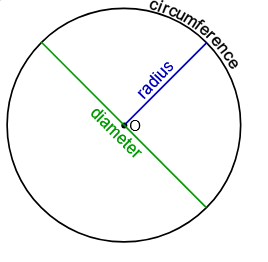
Very simply, it is half the diameter of a circle. The full width is called the diameter and the outer edge the circumference. The circumference adds up to a total of 360 degrees, this will be important later. Luckily I have a handy drawing for you to make it a little easier to visualize.
Still awake at the back? Good. You will notice this looks suspiciously like a circle of Unitrack, which is very convenient!
So how do I actually work it out?
Helpfully, KATO sell all their curves with the radius marked on the packaging! For example 20-120's full legal name is 20-120 R315-45 Curved Track. This tells us it has a radius of 315mm and it covers 45 degrees of the circumference.
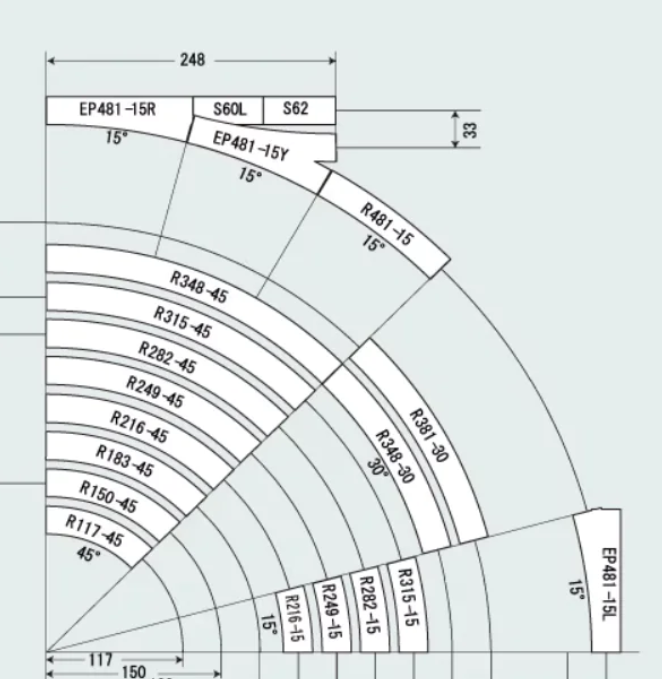
The radius of the track is measured from the center-line between the rails, as you can see in this diagram with the lines joining the track centers.
So we now know that over 90 degrees the center point of the rails to the end of the track will take up 315mm and we need two pieces to do it (45 degrees x 2 = 90 degrees)! You can see examples of the measurement above with the 117mm and 150mm in the bottom left corner. Working out the diameter is just multiplying the radius by 2, thus 2 x 315 = 630. Hey presto, we now know that if we want to make a complete turn for say the end of the oval, there will be 630mm between the center of the track on opposite sides. We also know it will take four pieces of track, as 45 x 4 = 180.
But wait, I hear you shout, my curve with a diameter of 630mm does not fit in my 630mm space! This is because we have yet to take into account that the track is wider than the radius measurement! Luckily we know how wide our track is!
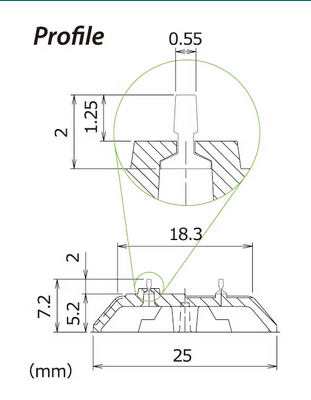
From each side of our radius measurement (marked in the center of the diagram) there is 12.5mm of track and roadbed. So we add this on to find the outer circumference and subtract it to find the inner circumference. For example going back to our above examples, we know the R315 curve will take up 630mm over 180 degrees. We add to this the sides of the track, 12.5mm x 2 = 25mm. So in total the R315 will take up 655mm. (630mm + 25mm.) If we were measuring a 90 degree corner, we would only have to add or subtract 12.5mm.
But what about double track? That's wider! It sure is, but luckily there is still only 12.5mm from the radius to the edge of the roadbed. Double track corners come with the inner and outer radius marked on the packaging. For example 20-185 R480/447-45 tells us the inner track has a radius of 447mm and the outer track has a radius of 480mm and it covers 45 degrees. For the outer diameter of the track you add to the larger radius as above and for the inner diameter you subtract from the inner radius just as above!
To summarize
If you've made it this far, well done!
Finding out how much room curves take up in Unitrack is done simply with a little math. -R number x 2 + 25 = The outer diameter of a 180 degree curve. Subtract 25 for the inner diameter. -R number +12.5 = The outer diameter of a 90 degree curve. Subtract 12.5 for the inner diameter.
For double track do exactly the same as above, but add to the larger R number and subtract from the smaller R number.
I will leave you with a link for the Unitrack website, which as you scroll down has a very handy diagram of all the Kato Unitrack pieces and how they fit together!