



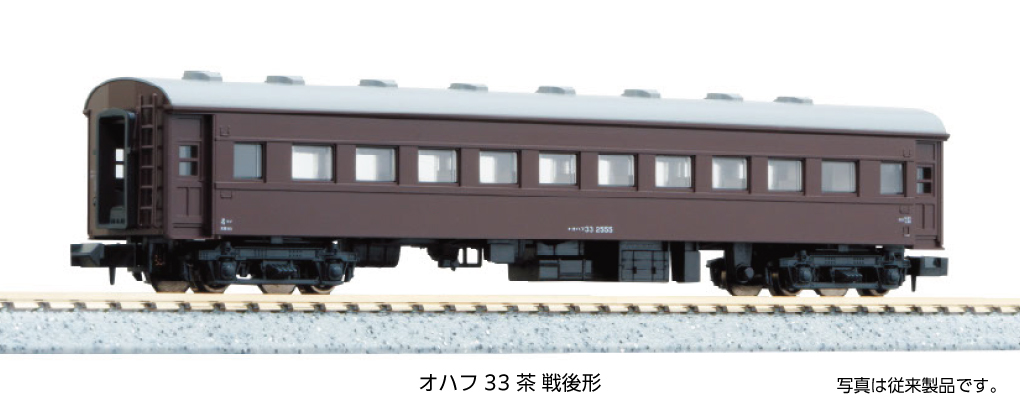


Description
The Oha 35 series was one of the most representative passenger car models of the prewar Japanese National Railways, with over 2,000 cars mass-produced, making it the most numerous passenger car series in Japan. It debuted in 1938 with a gabled roof, round roof, 1-meter-wide passenger windows, TR23 bogies, and extensive use of welding. Prewar production ceased in 1942, but when production resumed after the war, a combination of material availability and advanced construction methods resulted in a unique design that could be classified as a "postwar model." The bogies were also upgraded from the TR23 plain bearings to the TR34 type, which replaced domestically produced roller bearings. Widely deployed throughout the country, they were seen in action on everything from express trains to local trains.
This new model features a separate roof ventilator, allowing for enhanced detailing. The standard model is available in modernized blue, while the postwar model is available in pre-modernized brown. This model recreates the transitional period seen from the 1960s onwards. Many of the locomotives from the JNR era, including the 3087-1 ED71 First Generation, which will be released at the same time, are recommended for use as traction locomotives.
Features
1) The general-purpose type has a sturdy style with extensive use of rivets, reminiscent of old-style passenger cars, while the post-war type accurately reproduces the characteristics of the end panels, which have been described as "mushrooms and slices of bread."
2) The ventilators on the roof are expressed as separate parts.
3) The standard paint color of old JNR general-purpose passenger cars is beautifully expressed.
4) The brown color is reminiscent of the original vehicle, with wooden doors. The blue version is modeled after an updated model, featuring metal doors with H-shaped rubber bands.
⑤ The Oha-Fu 33 features taillights on the brake/emergency compartment side (with a switch to turn them off).
⑥ Arnold couplers are standard equipment.
⑦ The designations for each vehicle are as follows: Oha-Fu 33 Brown (Postwar): Oha-Fu 33 2583 (Sensen), 47-3 Tsuchizaki Technical High School


Reviews
There are no reviews yet.